
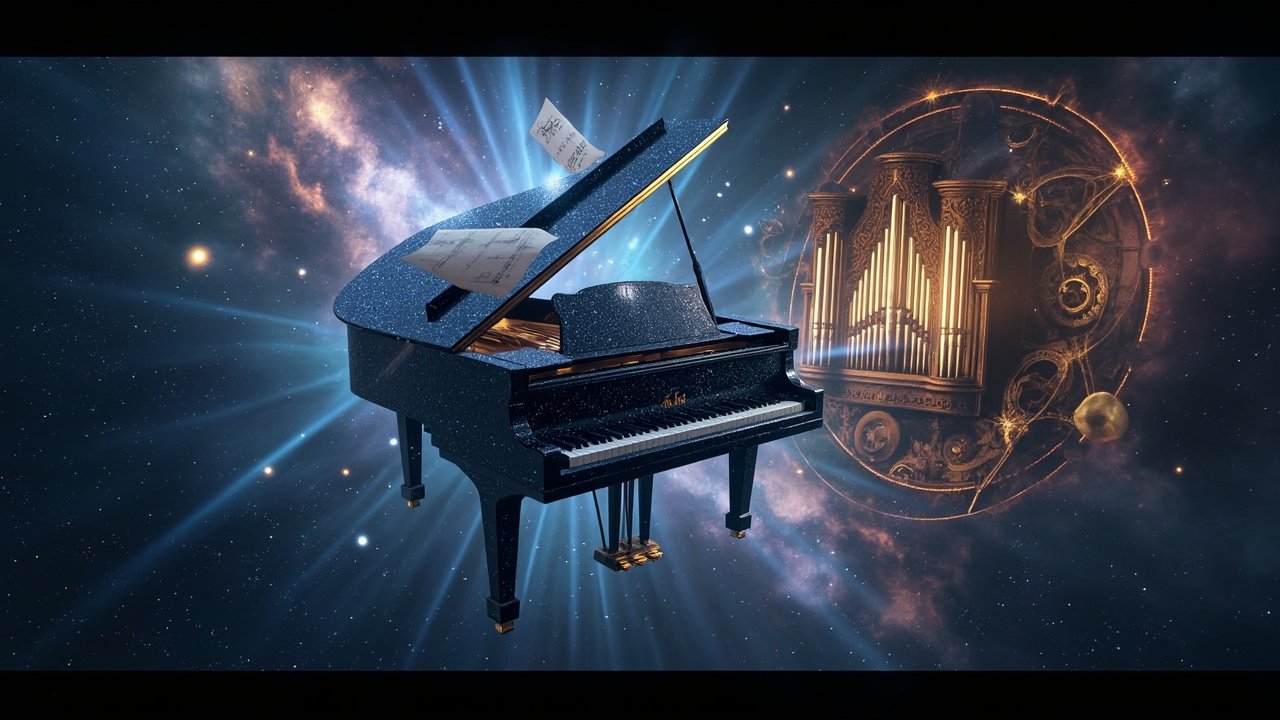
sWhat if a film score could be a rigorous intellectual exercise in theoretical physics, not just an emotional guide? Hans Zimmer’s work for Interstellar operates on this revolutionary dual track, transforming abstract concepts like relativity and time dilation into a visceral sensory experience. This cinematic masterpiece uses the very architecture of music—from a massive church organ’s gravitational pull to a meticulously calculated ticking clock—to sonically illustrate the laws of the cosmos, creating a score that transcends the sci-fi genre.
Click to download the Interstellar Piano Sheet Music (PDF)
The Unseen Architecture of a Cinematic Masterpiece
We often think of film scores as emotional guides, but what if they could also be rigorous intellectual exercises? Hans Zimmer’s work for Interstellar operates on this dual track. It’s not merely accompaniment; it’s a structural component of the film’s universe, built from the very physics it seeks to portray. The genius of the score lies in its ability to make abstract scientific concepts feel visceral, transforming theory into sensory experience.
Why This Score Transcends Sci-Fi
The score for Interstellar does something remarkable: it uses the language of music to articulate the laws of the cosmos. It transcends the sci-fi genre not by ignoring its conventions, but by grounding them in a sonic reality that feels both ancient and futuristic. This isn’t the typical orchestral fanfare for space adventure; it’s a meditation on time, love, and gravity, expressed through a radical fusion of organ and orchestra.
The Emotional Physics of the Organ
At the heart of the score’s gravitas is a 1926 Harrison & Harrison organ housed in London’s Temple Church. Zimmer didn’t use this instrument for its religious connotations, but for its physical properties. The sound it produces is not just heard; it’s felt—a deep, vibrating resonance that one could describe as weighing over 30 tons. This isn’t a metaphorical weight, but a perceptual one, pressing down on the listener to mirror the immense gravitational forces at play in the narrative.
Furthermore, the harmonic structure of the main themes often avoids traditional resolution. Zimmer creates a sense of vast, open space and perpetual motion by using musical intervals that feel both expansive and unresolved. This compositional choice is a direct nod to Einstein’s theory of relativity, where space-time is curved and there are no absolute rest frames—only relative motion. The music itself refuses to sit still, sonically illustrating a universe in constant, relative flux.
The Hidden Ticking Clock
Beneath the sweeping melodies and organ chords lies a persistent, metronomic ticking. This is not a random effect but a meticulously calculated element. The ticking represents the unrelenting passage of time, and more specifically, the time dilation experienced by the crew on their planetary missions. Every tick is a second lost forever on Earth, a constant auditory reminder of the mission’s stakes.
The psychological impact is amplified by the chosen tempo. The clock ticks at 60 beats per minute. This is not an arbitrary number; it mirrors the average resting heart rate of a human being. By aligning the score’s fundamental pulse with our own biology, Zimmer creates a subconscious, empathetic link between the audience and the astronauts. When the characters are under stress, our own internal rhythm syncs with this external, ticking clock, making their anxiety our own.
Hans Zimmer’s Radical Composition Process
To create a score that felt truly revolutionary, Zimmer knew he had to abandon the very tools and traditions that had defined his previous work. The process for Interstellar was one of deliberate deconstruction and scientific collaboration, resulting in a composition that is as much a piece of theoretical exploration as it is a piece of art.
Rejecting Traditional Methods
Zimmer made a pivotal decision at the outset: he would not compose the score on a piano, his primary instrument. He felt the piano’s familiar tempered scale was too “earthbound” for a story about transcending known dimensions. Instead, he started with the church organ and vast, electronic soundscapes. He employed mathematical concepts to structure his themes, using numerical patterns and algorithms to generate melodic and harmonic ideas that felt organic yet unfamiliar. This was not music designed for easy listening; it was music designed to model the complex, non-linear realities of theoretical physics.
The Collaboration That Changed Everything
The most critical partnership on the film was not between Zimmer and director Christopher Nolan, but between the composer and Nobel laureate physicist Kip Thorne. Thorne, who provided the scientific foundation for the film’s black hole and wormhole visuals, also directly influenced the music. Zimmer and Thorne had long conversations about the physics of time, gravity, and relativity.
This dialogue moved from abstract theory to concrete musical decisions. Thorne’s explanations of time dilation directly inspired the pervasive ticking clock motif. The idea that gravity could transcend dimensions found its way into the score’s layered, interweaving themes. This collaboration ensured that the score wasn’t just emotionally resonant but was also, in its own abstract way, scientifically accurate. It stands as a powerful testament to the intersection of scientific inquiry and artistic expression, where one discipline feeds and elevates the other.
Click to download the Interstellar Piano Sheet Music (PDF)
How Beginners Can Learn Interstellar Piano Sheet Music
Learning to play the Interstellar theme is not merely an act of musical reproduction; it is an exercise in translating cosmic scale into the intimate confines of a keyboard. The piano arrangement serves as a blueprint, a schematic that, when followed with intent, allows you to reconstruct the physics and emotion of Zimmer’s universe from your living room. It is a form of time travel, where your fingers become the vessel navigating the gravitational fields encoded in the sheet music.
Decoding the Piano Arrangement
The genius of a well-crafted piano reduction lies in its ability to create the illusion of a full orchestra. It is a feat of musical engineering, distilling the essence of a massive, multi-layered soundscape into a format that can be rendered by ten fingers. The challenge, and the triumph, is in what is preserved and how it is translated.
From Cosmic Orchestra to Solo Piano
The primary technical challenge in arranging the Interstellar theme for piano is the condensation of its vast textural layers. The original score features a monumental church organ, a full string section, and ethereal synthesizers, all operating in distinct frequency ranges. The piano arrangement must find a way to imply this breadth. It does so not by attempting to play every single note, but by strategically outlining the harmonic framework and prioritizing the most melodically and rhythmically critical voices.
The emotional impact is preserved through the intelligent use of dynamics and voicing. The powerful, sustained organ chords are transformed into rich, widely-spaced piano chords, often using the sustain pedal to create a similar sense of lingering resonance. The high, searching string melodies are given to the right hand, which must play with a lyrical, singing tone to replicate their soaring quality. The arrangement forces the pianist to become a conductor of sorts, balancing these implied textures in real-time.
The Left Hand’s Gravitational Pull
In the orchestral version, the organ provides the foundational weight—the sonic gravity. In the piano arrangement, this crucial role falls entirely to the left hand. The left-hand patterns are not mere accompaniment; they are the engine room of the piece, creating the score’s weighty, atmospheric pressure.
| Technique | Function | Practice Focus |
|---|---|---|
| Broken Octaves & Fifths | Creates a rolling, sustained low-end presence that mimics the organ’s pedal tones. | Focus on evenness and depth of touch, using arm weight to produce a full, non-percussive sound. |
| Widely-Spaced Chords | Establishes the harmonic bedrock and sense of vast space. | Practice hand stretches slowly to ensure accuracy and avoid tension; rotate the wrist to connect notes smoothly. |
| Synchronized Rhythmic Pulsing | Anchors the piece and reinforces the “ticking clock” motif. | Use a metronome religiously to lock in the unwavering pulse against the more fluid right-hand melody. |
The specific technique for maintaining this low-end presence lies in a deliberate, weighty touch and a keen awareness of the sustain pedal. The goal is to let the low notes ring and blend, creating a pad of sound over which the melody can float, rather than letting them sound as disconnected, staccato notes.
Practice Strategies That Defy Time
Mastering a piece of this emotional and technical depth requires a strategy as disciplined as the composition itself. Haphazard practice will only lead to frustration. A methodical, almost scientific approach is needed to build the necessary muscle memory and interpretive control.
Building Finger Memory for Complex Passages
The most intricate sections, particularly the flowing, arpeggiated passages, can feel overwhelming. The key is to deconstruct them using the “chunking” method. Instead of trying to play a long, complex run from start to finish, break it down into smaller, logical groups of 3, 4, or 5 notes. Master each “chunk” individually, at a painfully slow tempo, focusing on perfect fingering and effortless motion. Only once each chunk is secure do you begin to link them together, first in pairs, then in larger groups.
To practice the arpeggiated sections with scientific precision, isolate the hand position shifts. Play the first note of an arpeggio, then silently move your hand to the position required for the next note, ensuring the movement is efficient and relaxed. Repeat this process until the shifts feel automatic. This isolates the geography of the keyboard from the complication of sound, allowing your brain to map the physical movements with clarity.
Tempo Mastery Through Metronomic Discipline
The persistent, ticking heartbeat of the score demands absolute rhythmic integrity. The most effective way to achieve this is through a rigorous, graduated tempo strategy. Do not start at the performance speed.
- Begin at 40 BPM. This painfully slow tempo is not for musicality, but for forensic accuracy. It allows you to place every single note perfectly in time, with the correct fingering and dynamics, without any guesswork.
- Increase by increments of 4-6 BPM. Only when you can play the entire piece flawlessly and comfortably at one tempo should you increase the metronome. If you make a mistake, you have increased the speed too soon. Drop back down 2 BPM and solidify your control.
- Focus on consistency through dynamics. The ultimate test is maintaining this rock-solid pulse while executing the piece’s powerful crescendos and delicate decrescendos. The pulse must be immutable, like the passage of time itself, regardless of the emotional intensity.
This disciplined journey from the microscopic focus of 40 BPM to the final performance tempo is what builds a rendition that is not just played, but engineered—a stable structure capable of supporting the immense emotional weight of the music. To begin your own journey of deconstruction and mastery, the essential tool is the Interstellar Piano Sheet Music (Easy & Original PDF). You can access this blueprint for musical time travel here: [Product Link].
Transforming Practice Into Performance

Mastering the notes of the Interstellar theme is a significant technical achievement, but it is merely the first step. The true challenge, and the ultimate goal, lies in transforming that technical execution into a performance that breathes, swells, and tells a story. This is the moment you stop playing the piano and start playing the cosmos.
From Technical Execution to Emotional Storytelling
The difference between a correct performance and a captivating one is the layer of narrative you choose to paint over the notes. Hans Zimmer did not compose in a vacuum; every bar is a direct response to the film’s heart-wrenching journey of love, sacrifice, and existential dread.
Understanding the Narrative Behind the Notes
To play this piece compellingly, you must internalize its correspondence with the film’s plot. The piece is not a single emotion; it is an arc. The opening, with its simple, ticking pattern, is the launch sequence—the anxiety and anticipation of leaving everything known behind. The gradual introduction of the melody represents the vast, awe-inspiring, and terrifying beauty of the cosmos. The swelling middle section, where the organ’s influence is most keenly felt on the piano, is the gravitational slingshot around Gargantua, a moment of sheer, unimaginable power and temporal distortion. The final, quiet resolution is not a happy ending, but the bittersweet acceptance of Cooper’s fate, a poignant blend of loss and hope. When you practice, you are not just running scales and chords; you are rehearsing this emotional journey. Your goal is to make the audience feel the lift of the rocket, the vertigo of the wormhole, and the quiet ache of a father’s love across dimensions, all without a single visual cue.
The Art of Dynamic Control
If there is one technical element that defines the Interstellar theme, it is the massive, slow-building crescendo—the “Zimmer swell.” On an organ, this is achieved with a volume pedal. On a piano, it is an act of physical illusion and supreme dynamic control.
Achieving this signature swell requires a conscious graduation of touch and power. It begins not with soft hands, but with heavy, relaxed arms, allowing the weight of your body to sink into the keys to produce a foundational, organ-like tone. As the phrase ascends, you must meticulously increase the keybed speed and arm weight, note by note, to create an unbroken line of increasing volume. This is not a sudden jump from mezzo-piano to forte; it is a seamless tidal wave of sound. Conversely, the balancing act in climactic sections is about power without harshness. Striking the keys with excessive force produces a percussive, brittle sound that shatters the atmospheric illusion. True power at the climax comes from depth and resonance, not attack. It is the difference between a shout and a roar.
Performance Psychology
Playing a piece as iconic and emotionally charged as this one can be as much a psychological challenge as a technical one. The specter of the masterpiece can be intimidating, but it can also be your greatest source of motivation.
Overcoming the Intimidation Factor
The key to overcoming intimidation is to reframe the piece from an impenetrable monolith into a series of manageable, solved problems. You have already deconstructed it into hands-separate exercises, slow tempos, and small sections. Confidence is built through the evidence of these small, daily victories. Instead of thinking, “I have to perform the Interstellar theme,” focus on the immediate goal: “I will perfect the transition into the B section at 60 BPM today.” This structured, incremental practice provides tangible proof of progress, systematically dismantling the fear of the whole. The piece becomes not something you are struggling against, but something you are methodically building, one secure brick at a time.
Connecting with Your Audience
When you perform this piece, you are the sole vessel for a cosmic narrative. Without visual aids, the responsibility falls entirely on your musical storytelling to create an immersive experience. This connection is forged long before the first note is played. It begins with your own mental preparation—visualizing the scenes, re-feeling the emotions as you play. Your posture, your breathing, and the focus in your eyes communicate intent to the audience before a sound is made.
As you play, you are not just activating keys; you are controlling time and space through rhythm and dynamics. The steady, ticking pulse should feel inevitable, like the passage of time itself. The rubato you employ in the melodic phrases should feel like the gentle, human pull against that inevitability. You are inviting the audience to close their eyes and not just hear a piano, but to see stars being born, worlds ending, and a single spaceship journeying into the infinite. Your performance is a vehicle for their imagination. To embark on learning this journey for yourself, the foundational Interstellar Piano Sheet Music (Easy & Original PDF) is your essential chart. You can access it here: [Product Link].
Beyond the Score: Your Musical Universe Awaits
The journey of learning Hans Zimmer’s Interstellar does not end with a flawless performance. That performance is, in fact, a beginning. It marks your entry into a different echelon of musicianship, one where a single piece of music can fundamentally alter your technical approach and creative outlook. The true value of conquering such a work is not just the ability to play it, but the permanent upgrade it provides to your entire musical operating system.
The Ripple Effect of Mastering Complex Repertoire
What you learn from the Interstellar theme does not stay confined to those few pages of sheet music. The skills are deeply transferable, creating a ripple effect that enhances everything you play thereafter.
Technical Benefits That Transfer
The technical demands of this piece are a masterclass in several core piano techniques. The relentless, steady pulse of the left hand, often in compound time, is a rigorous workout for rhythm internalization and hand independence, curing a reliance on a rigid, metronomic feel and replacing it with a fluid, yet unwavering, sense of time. The piece’s requirement for a powerful, resonant tone, achieved through arm weight rather than finger force, fundamentally improves your touch, teaching you how to fill a physical space with sound without resorting to harsh, percussive attacks. This newfound ability to produce a “big” yet beautiful sound is instantly applicable to everything from Beethoven to modern jazz.
Perhaps the most significant transferable skill is the advanced development of musical interpretation. You are forced to move beyond the binary of “loud” and “soft” and learn to operate within a vast, continuous spectrum of dynamics. The patience required to build a crescendo over eight bars, or to execute a decay with emotional intent, cultivates a level of dynamic control that will make the phrasing in simpler pieces profoundly more expressive. You learn that music exists not in the notes, but in the spaces between them—in the subtle delays, the slight hesitations, and the controlled swells that give it a human pulse.
Creative Applications
Once internalized, the architectural concepts of the Interstellar theme become tools for your own creativity. The piece is a case study in building immense emotional weight from a deceptively simple motif. Composers can dissect how Zimmer uses a repetitive, ticking pattern not as a mere background element, but as the foundational rhythmic and harmonic engine of the entire piece. This teaches the power of ostinato and minimalism in creating tension and atmosphere.
The cinematic techniques you absorb—the use of space, the slow textural builds, the emotional mapping of a narrative onto a musical structure—are not genre-specific. You can adapt them to an original ballad, an electronic track, or a film score of your own. Understanding how to musically represent concepts like vastness, tension, and release allows you to paint with a much broader emotional palette, regardless of the style of music you are creating.
Continuing Your Musical Journey
After the gravitational pull of Interstellar, where does your musical spacecraft go next? The skills you’ve acquired have prepared you for a wider universe of cinematic and contemporary repertoire.
| Recommended Next Piece | Composer | Why It’s a Logical Next Step |
|---|---|---|
| “Time” | Hans Zimmer (from Inception) | Builds on emotional crescendos and arpeggiated structures, with a more pronounced melody. |
| “Cornfield Chase” | Hans Zimmer (from Interstellar) | A companion piece that explores a lighter, more rapid and intricate arpeggiated pattern. |
| “The Heart Asks Pleasure First” | Michael Nyman (from The Piano) | Develops further the use of repetitive, driving patterns to build a powerful emotional narrative. |
| “Comptine d’un autre été : L’après-midi” | Yann Tiersen (from Amélie) | Focuses on melodic clarity and rhythmic precision within a minimalist framework. |

 – Learn Hans Zimmer’s Masterpiece)
No comment