

What if the simplest melody could unlock your musical potential? Learning ‘Twinkle Twinkle Little Star’ on piano provides far more than childhood nostalgia—it establishes crucial foundational skills through its universally recognizable structure. This timeless piece offers immediate motivation through familiar tones while teaching proper finger positioning, basic rhythm, and note recognition in a comfortable five-finger scale pattern. Perfect for both young children and adult beginners, mastering this classic tune creates a gateway to more complex musical pieces while building confidence from the very first session.
【Your First Piano Adventure】
Why Start With This Timeless Melody?
It is a truth universally acknowledged, that a person in possession of a new piano must be in want of a first song to play. Where, then, could one possibly begin, if not with the charming and familiar strains of “Twinkle, Twinkle, Little Star”? Its virtues for the novice are numerous and undeniable.
- Universal recognition creates instant motivation. From the very first note, your fingers will trace a melody known to you since childhood. This immediate connection banishes the strangeness of the instrument and replaces it with the delightful shock of producing something you truly recognise. It is a most encouraging commencement.
- Simple melodic structure builds foundational skills. The tune is constructed upon a straightforward scale, teaching the beginner the very geography of the piano keyboard without the burden of complexity. Your hand learns to move with a natural and graceful ease.
- Perfect finger positioning for beginner hands. The required notes sit comfortably under the hand, promoting a proper and relaxed posture. One is not required to stretch or strain, thus establishing good habits from the outset.
- Immediate sense of accomplishment. To play a complete and beloved air from beginning to end within a single practice session is a triumph of no small magnitude. It is a reward that fuels the desire to continue one’s musical studies.
The Perfect First Song for All Ages
While its simplicity is universal, its application may be most agreeably tailored to the age and disposition of the player.
For Young Children (3-5 years)
The mind of a young child is a wondrous thing, though not always suited to lengthy instruction. For them, the approach must be one of engagement and delight.
- Large notation for developing eyesight: The sheet music must be presented with notes and staves of a considerable size, making it easy for young eyes to distinguish one symbol from another.
- Story-based learning approach: The learning of the notes can be woven into the tale of a little star’s journey across the night sky, where each note is a step in its adventure.
- Color-coded finger positioning: A most effective scheme involves assigning a colour to each finger used in the piece. The corresponding piano keys can then be marked, allowing the child to play by colour, thus learning the tune without the initial intimidation of standard notation.
- Short attention span consideration: Practice sessions should be brief but frequent, focusing on the joy of creating music rather than on perfection. A few minutes of happy practice is worth more than an hour of frustrated effort.
For Older Beginners (6+ years)
For the older beginner, whose capacities for reason and concentration are more developed, “Twinkle, Twinkle, Little Star” serves as a perfect introduction to the principles of music.
- Introduction to basic music theory: This simple melody provides the ideal context for learning one’s first notes on the staff, understanding the concept of measure and time signature, and recognising the difference between steps and skips in a melody.
- Foundation for more complex pieces: The skills honed in this piece—finding notes, moving the fingers in sequence, maintaining a steady pulse—are the very same skills required for the sonatas and concertos one may later aspire to play. It is the solid foundation upon which a musical education is built.
- Coordination development between hands: While the left hand may begin by playing single notes or simple chords to accompany the right, it is the first lesson in the delicate art of coordinating two hands to act in harmonious concert.
- Rhythm pattern recognition: The rhythm of “Twinkle, Twinkle” is wonderfully regular and repetitive, allowing the student to internalise a fundamental rhythmic pattern that appears in countless other compositions.
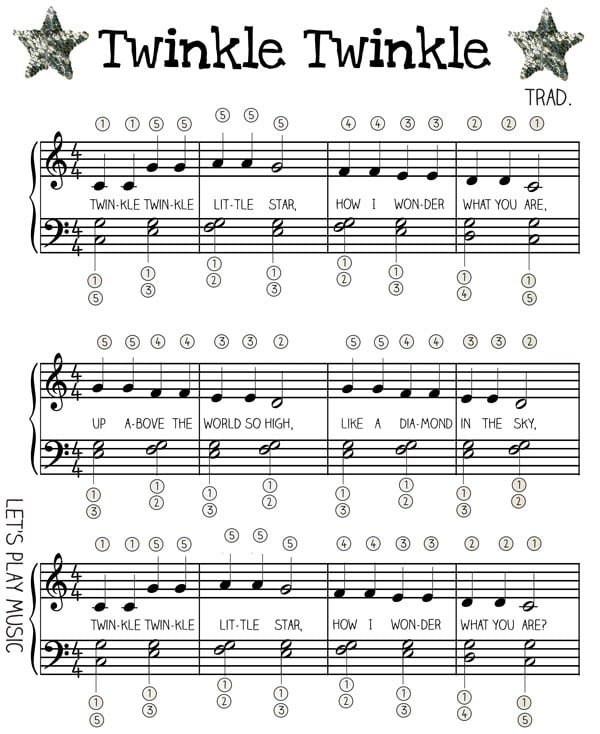
To aid you in this most delightful of endeavours, a specially arranged twinkle twinkle little star sheet music (Easy & Original PDF) is available for your practice. This resource provides both the simple, single-note melody for your first attempt and the original, more harmonious version by Mozart for when your skills have progressed.
- Product: Twinkle Twinkle Little Star Sheet Music (Easy & Original PDF)
- Link:Click to download Twinkle Twinkle Little Star sheet music
【Understanding Your Sheet Music】
Reading the Basic Notation
Having resolved to learn this charming air, you must now become acquainted with its written form. The sheet music, which may at first appear as a collection of curious dots and lines, is in fact a most logical and decipherable map.
Note Identification Made Simple
Let us begin our examination upon the terrain of the treble clef, where the melody of our little star resides.
- Middle C positioning and recognition: Your journey begins with Middle C, a note of singular importance. It is the anchor around which the beginner’s world revolves. You will find it on the piano by locating the key at the very centre, often directly beneath the brand name, and on the staff, it sits upon a short, added line below the five main lines of the treble clef. It is, one might say, the doorstep to the musical house.
- Five-finger scale patterns: The melody of “Twinkle, Twinkle, Little Star” is conveniently contained within a five-finger pattern. Place the fingers of your right hand upon five consecutive white keys, with your thumb (1) on Middle C. Your fingers, from thumb to pinky, will now rest upon C, D, E, F, and G. These are the very notes required to play the entire tune—a most efficient arrangement!
- Step-wise motion explanation: Observe how the melody often moves from one note to its immediate neighbour, such as from C to D or from E to F. This is called step-wise motion, and it is the most natural and comfortable movement for a beginner’s hand to execute. It feels as natural as walking up a gentle staircase.
- Repeated note patterns: You will also encounter instances where the same note is played twice in succession. This provides a moment of repose for the hand and reinforces the memory of that particular key’s location.
Rhythm Fundamentals
A melody is not merely a sequence of notes, but a sequence of notes held for specific durations. The rhythm gives the music its pulse and its life.
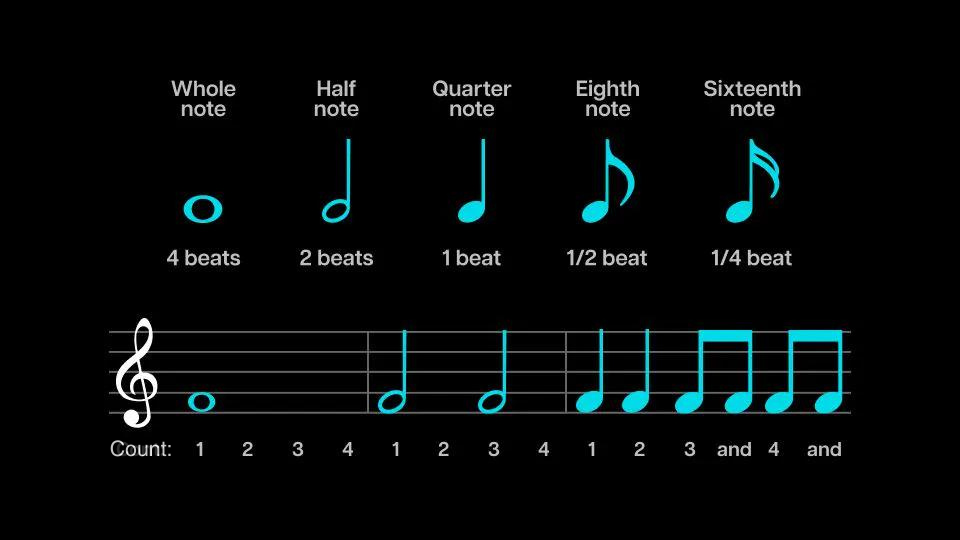
- Quarter note timing (1 beat per note): In the simplified version of our song, you will primarily encounter quarter notes. Each of these solid, black notes receives one steady beat. Imagine a steady, walking pace—that is the rhythm you must maintain.
- Consistent tempo maintenance: It is of utmost importance to keep a steady pace from the first note to the last. Whether you play quickly or slowly matters less than that you do not waver; a consistent tempo is the mark of a player who is in command of the music.
- Counting aloud technique: A most effective method for securing this steadiness is to count aloud as you play. A simple “1, 2, 3, 4” for each measure will anchor your fingers and prevent them from rushing ahead or lingering too long.
- Metronome practice benefits: Should you find counting aloud troublesome, a metronome serves as a perfectly steady and impartial companion. Its constant tick will guide your practice and instill in you a most reliable internal sense of timing.
The Original vs. Simplified Arrangements
It is a curious and delightful fact that the simple air we are studying exists in two distinct forms: the humble melody known to every child, and a sophisticated set of variations composed by the great Wolfgang Amadeus Mozart himself.
Original Composition Elements
The history of the melody is as rich as its musical potential.
- Mozart’s variations complexity: When the renowned composer turned his attention to “Ah! vous dirai-je, maman” (the French folk song that shares our melody), he did not merely play the tune. He created twelve dazzling variations, each more intricate than the last, transforming the simple star into a constellation of musical brilliance. This original arrangement features rapid scales, arpeggios, and dynamic shifts, presenting a worthy challenge for the advanced pianist.
- Historical context of the melody: The tune is far older than Mozart, with its origins as a French folk song in the 2025s. Its charming and adaptable nature is what has allowed it to traverse centuries and cultures, and to serve as the foundation for both a nursery rhyme and a masterpiece of classical music.
- Traditional French folk origins: The melody was first known for the song “Ah! vous dirai-je, maman,” which laments the troubles of love and life. Its cheerful tune belies its original, more wistful lyrics.
- Advanced arrangement challenges: To attempt Mozart’s variations is to engage with hand independence, ornamentation, and velocity—skills far beyond the scope of a first lesson, but a glorious aspiration for the future.
Beginner-Friendly Modifications
For our present purposes, however, we must embrace the virtues of a simplified arrangement, which is designed not to diminish the tune, but to make it accessible.
- Reduced note range (C to G): As previously noted, the easy version confines itself to the five notes from C to G, keeping the hand in a comfortable and stable position.
- Simplified rhythm patterns: The relentless quarter-note rhythm of the easy arrangement allows the beginner to focus on note accuracy without the added complication of varying note lengths.
- Larger notation sizing: The sheet music is often printed with enlarged staffs and noteheads, a kindness to the eyes of a new reader who is yet unfamiliar with the dense landscape of standard musical notation.
- Finger number indications: Above or below many notes, you will find small numbers indicating which finger (1 for thumb, 5 for pinky) is recommended to play it. This guidance is invaluable for establishing fluid and sensible fingering habits from the very beginning.
To facilitate your practice of both the simple air and its more illustrious original form, the twinkle twinkle little star sheet music (Easy & Original PDF) provides both arrangements in one convenient document, allowing your musical journey to progress at its own natural pace.
- Product: Twinkle Twinkle Little Star Sheet Music (Easy & Original PDF)
- Link:Click to download Twinkle Twinkle Little Star sheet music
【Practice Techniques That Work】
Having acquainted yourself with the written page, the true endeavour begins at the keyboard. The path from a hesitant first note to a flowing performance is paved with patience and deliberate practice, a pursuit as rewarding as it is necessary.
Step-by-Step Learning Process
To attempt the entire air at once would be a most imprudent undertaking. A far more sensible method is to divide the labour, conquering each small part before assembling the whole.
Phase 1: Right Hand Mastery
Your initial focus must rest entirely upon your right hand, which carries the entire melody.
- Note-by-note learning approach: Do not look upon the piece as a single, formidable entity. Instead, regard it as a sequence of small phrases, perhaps two measures at a time. Play the first two notes, then the next two, ensuring each is correct before proceeding. It is a slow but sure method of advancement.
- Slow tempo establishment: Speed is the enemy of accuracy at this early stage. Choose a pace so slow that you cannot possibly make a mistake. This deliberate slowness allows your mind to properly instruct your fingers and builds a foundation of certainty.
- Muscle memory development: As you repeat these short phrases at this slow pace, a remarkable process begins. Your fingers start to learn the geography of the keys independently of your conscious thought. This “muscle memory” is the very essence of fluent playing, and it is only cultivated through thoughtful repetition.
- Gradual speed increase: Only when you can play a phrase perfectly three times in a row at your slow tempo should you permit yourself a slight increase in speed. This gradual acceleration, like the steady growth of a plant, ensures that your technique remains secure and does not falter.
Phase 2: Adding Musicality
Once the notes are secure under your fingers, the task shifts from mere execution to interpretation, from playing the notes to playing the music.
- Dynamic variation introduction: The sheet music is no longer a mere map of notes, but a script filled with expression. Experiment with playing one phrase softly (piano) and the next more loudly (forte). Perhaps the first “twinkle” could be gentle, and the second more bright, giving the melody a delightful conversation.
- Phrasing and breathing points: A melody breathes much like a sentence. Identify the natural points for a small pause or a lift of the hand—typically at the end of each line of the rhyme. This separates the musical thoughts and gives the performance shape and elegance.
- Expression marking interpretation: If your sheet music contains markings such as legato (smooth and connected) or staccato (short and detached), give them your full consideration. These are the composer’s instructions on the character of the piece, and adhering to them is a sign of a discerning player.
- Personal style development: As you grow more comfortable, allow your own feelings to guide you. Does a certain phrase sound sweeter if lingered upon? The development of your own musical voice, while respecting the composition, is the ultimate goal of practice.
Common Beginner Challenges
Every learner, no matter how diligent, will encounter obstacles. To be forewarned of them is to be forearmed.
Technical Difficulties
These are the physical trials of the aspiring pianist, each with its own solution.
- Finger strength building exercises: When your third finger feels weak or your fourth refuses to lift independently, do not despair. Practice playing each of the five notes (C-D-E-F-G) slowly and firmly, holding each one down and ensuring the others remain curled and relaxed.
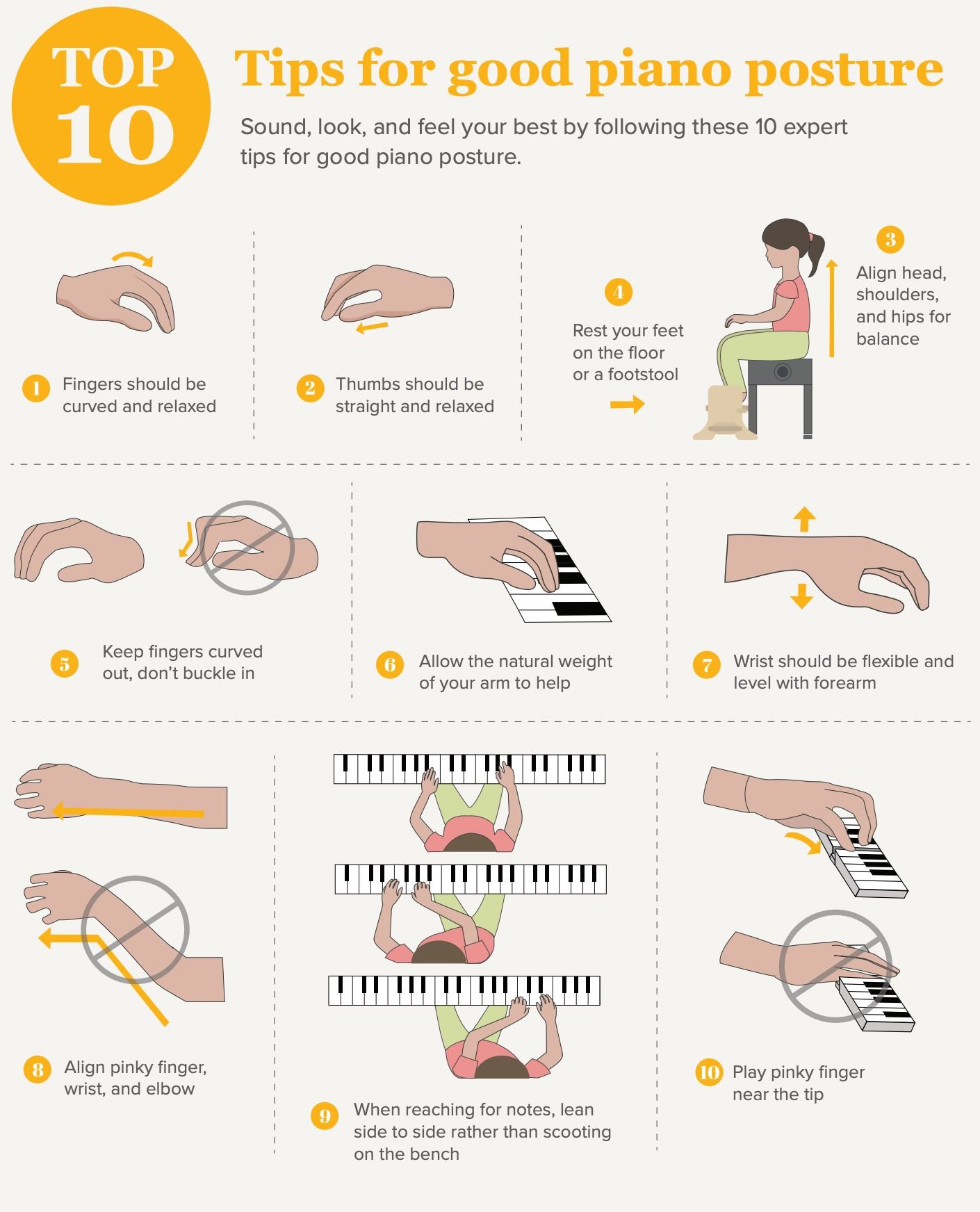
- Hand position correction: A slouching wrist or flat fingers are the cause of much fatigue and inaccuracy. Frequently check that your hand forms a gentle “C” shape, as if holding a small apple, with your fingertips poised upright on the keys.
- Note accuracy improvement: If you consistently play an F instead of a G, isolate that troublesome transition. Practice moving between just those two notes until the feel of the interval is ingrained in your hand.
- Smooth transitions practice: The joins between phrases can often be clumsy. Focus on making the last note of one phrase connect seamlessly to the first note of the next, as if drawing a single, unbroken line of sound.
Motivation Maintenance
The cultivation of a skill is a long engagement, and one’s enthusiasm may sometimes wane. A clever strategy is required to maintain one’s resolve.
- Short, frequent practice sessions: A quarter of an hour of focused practice each day will yield far greater progress than a single, wearying two-hour session once a week. Frequent, brief encounters keep the mind fresh and the memory strong.
- Celebrating small victories: Did you finally play that difficult bar correctly? That is a triumph worthy of acknowledgement! Take pleasure in these incremental achievements, for they are the steps by which you ascend.
- Variety in practice routines: To practice only “Twinkle, Twinkle” would be to invite tedium. Divide your time between the piece, the finger exercises mentioned previously, and perhaps the learning of a very simple scale. This variety keeps the mind engaged.
- Performance opportunities: As soon as you can play the piece through without stopping, share it. Play it for a fond parent, a trusted friend, or even for your own satisfaction recorded upon a device. The act of performance consolidates your learning and provides a most gratifying sense of accomplishment.
The comprehensive twinkle twinkle little star sheet music (Easy & Original PDF) is designed to support you through every stage of this journey, from your first note to your first foray into musical expression.
- Product: Twinkle Twinkle Little Star Sheet Music (Easy & Original PDF)
- Link: Click to download Twinkle Twinkle Little Star sheet music
【Beyond the Basics】

Having successfully mastered the simple melody of “Twinkle, Twinkle, Little Star,” a pupil may rightly feel a sense of accomplishment. Yet, the world of music is vast and full of further delights to be discovered. The true art of cultivation lies in building upon this success in a manner that is both structured and agreeable to one’s own tastes.
Building on Your Success
The transition from a first piece to a second is a step of some importance, for it sets the pattern for all future musical endeavours.
Next Songs to Learn
The selection of a subsequent piece ought to be guided by prudence and a little imagination. The aim is to reinforce newly acquired skills while gently introducing a new challenge, thus preventing the staleness that can arise from repetition without progression.
- Similar difficulty level pieces: To fortify your confidence, one might next attempt “Mary Had a Little Lamb” or “Hot Cross Buns.” These airs share a comparable simplicity in rhythm and a limited range of notes, making them a most natural and comfortable progression.
- Gradual skill progression: Once these are secure under the fingers, a pupil may carefully advance to slightly more complex nursery rhymes such as “Row, Row, Row Your Boat” or “London Bridge Is Falling Down.” These melodies often introduce a wider range of motion for the hand and more varied rhythmic patterns.
- Genre variety introduction: While the foundation is built upon these simple tunes, one may also wish to sample a different character of music. A simple arrangement of a well-known folk song like “Ode to Joy” from Beethoven’s Ninth Symphony or a basic minuet can provide a delightful change of scenery and taste.
- Personal interest consideration: Above all, let your own inclinations guide you. The pleasure of learning is greatly increased when the music itself is pleasing to the player. Whether it is a simple theme from a favourite film or a popular ballad, an arrangement that captures your fancy will provide the strongest motivation for practice.
Music Theory Foundation
To play the notes is one thing; to understand the principles which govern them is quite another, and it is this understanding that separates the mere player from the true musician.
- Scale pattern recognition: You will have observed that “Twinkle, Twinkle, Little Star” is constructed from the notes of the C Major scale. Practising this scale up and down the keyboard will familiarise your hand with its pattern, which is the very architecture of a great deal of Western music.
- Chord progression understanding: The harmony that supports a melody is built upon chords. In the key of C Major, the primary chords are C, F, and G. Learning to play these simple, three-note chords with the left hand will allow you to provide a pleasing accompaniment to your right-hand melodies.
- Key signature basics: The key of C Major, having no sharps or flats, is the most straightforward. Your next theoretical step is to comprehend the purpose of the key signature at the beginning of the staff, which informs the player which notes are to be consistently raised or lowered throughout the piece.
- Rhythm complexity building: Having conquered the even rhythm of quarter and half notes, one may gradually introduce the concept of the dotted half note or the eighth note, thus adding a new layer of rhythmic interest and challenge to your playing.
Creating a Practice Routine
Regularity in practice is of far greater consequence than the duration of it. A well-ordered routine, faithfully observed, is the surest path to steady improvement.
Daily Practice Structure
A session of thirty-five minutes, if properly organised, can yield remarkable progress. One might consider the following distribution of time to be both efficient and agreeable.
- Warm-up exercises (5 minutes): Begin by awakening the fingers with simple, slow exercises. Playing the C Major scale several times, with each hand separately and then together, prepares the muscles and the mind for the task ahead.
- Review material (10 minutes): Play through the pieces you have already mastered, such as “Twinkle, Twinkle, Little Star” and any others in your growing repertoire. This reinforces memory and builds fluency, allowing you to play with greater ease and expression.
- New material learning (15 minutes): Dedicate the heart of your session to the careful study of a new piece or a challenging section of a piece you are learning. Work slowly, hands separately at first, focusing on accuracy of notes and rhythm before attempting to increase the tempo.
- Fun playing (5 minutes): Conclude your practice by playing something you purely enjoy, without concern for error. This could be a favourite piece, an attempt to play a tune by ear, or simply improvising on a few chords. This ensures you always associate the instrument with pleasure.
Long-Term Progress Tracking
To maintain one’s enthusiasm over the course of weeks and months, it is beneficial to look up from the daily practice now and then to mark the journey’s progress.
- Weekly goal setting: Rather than a vague ambition to “get better,” set a specific, achievable goal for each week. This might be, “to play the first eight measures of my new piece without hesitation,” or “to master the C Major scale at 80 beats per minute.”
- Skill milestone celebration: Acknowledge and reward your achievements. The first time you play a piece from start to finish without error, or the day you successfully add chords with the left hand, is an event worthy of note and a small celebration.
- Repertoire expansion: Keep a list of the pieces you have learned to play comfortably. The satisfaction of watching this list grow is a powerful testament to your dedication and a constant reminder of how far you have come.
- Performance preparation: As your confidence grows, prepare a small piece to play for a trusted friend or family member. The act of preparing for a performance, however informal, focuses the mind and elevates one’s playing from a private exercise to a shared art.
For the scholar who has laid this admirable foundation, the journey into the world of music in 2025 is full of promise. To further your studies with a collection of pieces that build gracefully upon one another, our recommended resource provides a curated path forward.
- Product: Twinkle Twinkle Little Star Sheet Music (Easy & Original PDF)
- Link:Click to download Twinkle Twinkle Little Star sheet music
【Interactive Learning Elements】

The cultivation of a musical talent, while a deeply personal pursuit, need not be a solitary one. Indeed, the introduction of playful interaction and the judicious use of modern conveniences can transform the necessary diligence of practice from a duty into a delight. The aim is to engage the mind and spirit in a variety of ways, ensuring that the path to proficiency is as agreeable as it is instructive.
Making Practice Enjoyable
It is a truth universally acknowledged, that a young person in possession of a new skill must be in want of a engaging way to practice it. The clever application of game-like elements can provide the very motivation required to sustain one’s efforts.
Gamification Techniques
To introduce the spirit of a game into one’s practice is to disguise improvement as amusement. The following methods have proven most effective.
- Note recognition games: Instead of mere repetition, one might challenge oneself to name and play every ‘C’ on the keyboard within a time limit, or to identify notes on the staff with the alacrity of one solving a puzzle. This sharpens the mind as much as it trains the eye.
- Rhythm challenge activities: Clapping or tapping out the rhythm of a new piece before attempting to play it can be turned into a call-and-response game with a parent or a metronome. One might also attempt to decipher the rhythm of a familiar tune, such as a favourite nursery rhyme, by ear alone.
- Speed improvement tracking: As a piece becomes familiar, one may mark its initial tempo and then, over successive practice sessions, gradually increase the speed of the metronome. Charting this incremental progress provides a clear and satisfying visual of one’s advancing skill.
- Achievement badge system: A small chart, kept near the instrument, upon which one may affix a star or a checkmark for each piece mastered, each scale learned, or each practice session completed, serves as a tangible record of accomplishment and a spur to further effort.
Technology Integration
In this age of 2025, we are blessed with a variety of technological aids that were unavailable to musicians of a former time. These tools, used wisely, can be of immense service to the isolated pupil.
- Digital metronome apps: The steady tick of the mechanical metronome is a sound familiar to all music students, but its digital successor offers greater flexibility, often including different time signatures and visual cues, all from a device that is likely already close at hand.
- Recording and playback: The ability to record one’s own playing is a most instructive tool. Hearing a performance from the perspective of an audience reveals nuances of timing and dynamics that may escape the player in the moment of execution.
- Online tutorial videos: For the learner who may wish to see a difficult passage demonstrated, or to hear the proper phrasing of a piece, the internet offers a vast library of tutorials. One may observe the positioning of the hands and the touch upon the keys from the finest teachers, all from the comfort of one’s own home.
- Virtual teacher feedback: For those without regular access to an instructor, some platforms now offer the possibility of submitting a recording for professional critique. This can provide invaluable, targeted advice to correct habits of which the pupil may be quite unaware.
Family Involvement Strategies
The support and encouragement of one’s family can provide the foundation upon which a lasting love for music is built. Their involvement need not be that of a master instructing an apprentice, but rather of a sympathetic audience and a cheerful companion.
Parent Support Methods
A parent’s role is not to command, but to facilitate; not to criticise, but to encourage. Their quiet support is the soil in which confidence grows.
- Practice encouragement techniques: Rather than a command to “go and practice,” a parent might enquire, “Shall we hear what you have learned this week?” or, “I should very much like to hear your new piece.” This frames the activity as a sharing of joy rather than the fulfilment of an obligation.
- Progress recognition systems: A parent who takes note of a child’s growing repertoire, who remarks upon the increased smoothness of a scale or the confidence of a performance, provides the kind of sincere praise that fuels continued effort.
- Performance audience provision: The willing provision of an audience, however small, for a weekly “mini-recital” of pieces learned, gives purpose to practice and helps to accustom the player to the experience of performing, thus building poise.
- Resource organization help: A parent can be of immense practical help by ensuring that the sheet music for the pupil’s current studies, such as the “Twinkle Twinkle Little Star Sheet Music (Easy & Original PDF),” is neatly organised and readily at hand, thus removing a small but significant obstacle to regular practice.
Sibling Participation
Where siblings are present, they may be drawn into the musical pursuits of the house in a manner that promotes harmony both in life and in art.
- Duet arrangement possibilities: A simple melody, such as “Twinkle, Twinkle, Little Star,” can often be found arranged for four hands. A sibling, even one with no musical training, can often learn a simple, repeating accompaniment, allowing for the shared joy of creating music together.
- Audience role playing: A sibling can be the most appreciative (or most discerning) member of a pretend audience, helping to make the act of performance a familiar and less daunting prospect.
- Practice buddy system: Setting a shared, quiet time for independent pursuits—one sibling practicing an instrument, another reading or drawing—creates a supportive atmosphere of concurrent concentration.
- Musical game creation: Siblings may collaborate to invent their own games, perhaps guessing the name of a tune from a few played notes, or creating a simple story to accompany the mood of a piece.
For a family seeking to embark on this harmonious journey together, having the right materials from the outset is paramount. A well-structured resource can provide the foundation for all these interactive and supportive activities.
- Product: Twinkle Twinkle Little Star Sheet Music (Easy & Original PDF)
- Link:Click to download Twinkle Twinkle Little Star sheet music
【Troubleshooting Common Issues】
It is an unfortunate but inevitable aspect of any worthwhile endeavour that one will, from time to time, encounter difficulties. The path to musical proficiency is no exception, being occasionally strewn with technical frustrations and lapses in confidence. Yet, with a little foresight and the application of sound principles, these obstacles may be overcome, often leaving the pupil stronger and more resilient for the experience.
Technical Problem Solutions
The initial physical acquaintance with an instrument is often where the most persistent habits, both good and ill, are formed. Attending to these fundamental technicalities with care is therefore of the utmost importance.
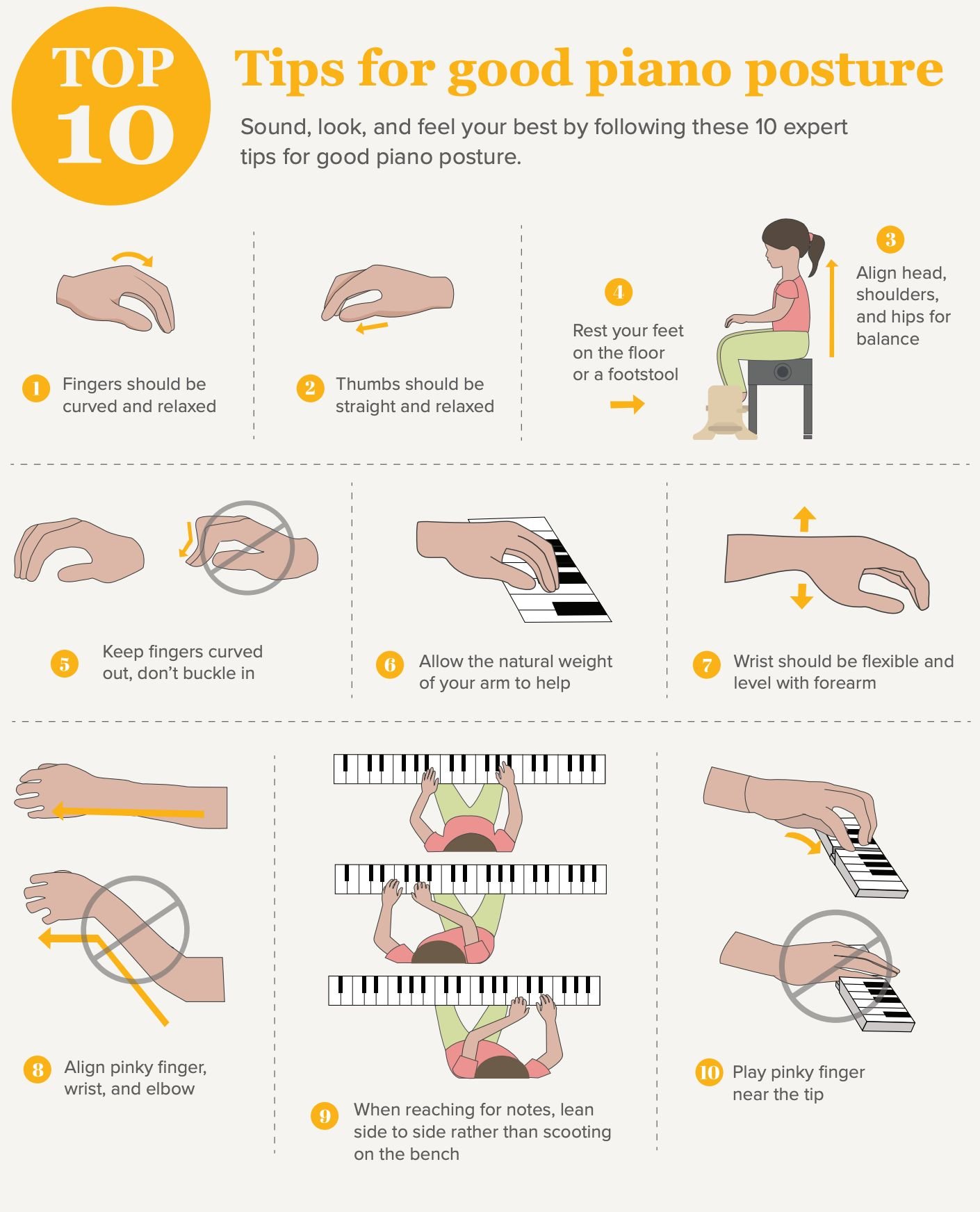
Hand Position Corrections
A proper hand position is the very foundation upon which ease of playing is built. Without it, progress is hindered and the risk of discomfort is increased.
- Wrist elevation adjustment: The wrist ought to be held level, neither sagging downwards towards the keys nor perched too high above them. Imagine balancing a small, precious object on the back of the hand; this will encourage a naturally buoyant and flexible position.
- Finger curvature maintenance: The fingers should be gently curved, as if resting upon a large sphere. One must avoid the extremes of collapsed, flat fingers or overly hooked, tense claws. This curvature allows for both strength and agility.
- Thumb positioning guidance: The thumb should approach the keys with its tip, not its side, resting lightly. It is a common error to allow the thumb to hang too low below the level of the keys, which disrupts the natural line of the hand.
- Relaxation techniques: Before and during practice, consciously check for tension in the shoulders, arms, and hands. A brief, gentle shaking of the limbs can release unwanted stiffness. Remember that power comes from controlled relaxation, not from rigid force.
Rhythm Challenges
The mastery of rhythm is as much a matter of the intellect as of the ear. A steady, internal pulse is the conductor that guides the performance.
- Clapping exercises: Before attempting a piece at the instrument, one should clap the rhythm of each hand separately whilst counting aloud. This separates the challenge of rhythm from that of pitch and fingering.
- Counting system establishment: One must cultivate the habit of counting sub-divisions. For a piece in 4/4 time, for instance, counting “1-and-2-and-3-and-4-and” provides a much more precise internal grid than counting “1-2-3-4” alone.
- Subdivision practice methods: When a particular rhythm proves troublesome, slow the tempo drastically and practice with a highly subdivided count. Only when the rhythm is perfectly secure at a slow tempo should the speed be gradually increased.
- Metronome dependency reduction: While the metronome is an invaluable tool for establishing tempo, one must not become a slave to its relentless tick. Use it to check your pulse, then turn it off and practice maintaining that steady pulse independently, lest your playing become mechanical.
Motivation and Frustration Management
The vicissitudes of the spirit can prove a greater impediment to progress than any technical difficulty. Managing one’s own expectations and emotional state is therefore a critical skill for the musician.
Practice Plateaus
It is a truth not universally acknowledged, but keenly felt by all serious students, that progress is not always a linear ascent. There will be periods where improvement seems to halt, a most trying circumstance for the eager pupil.
- Variation introduction: When progress on a primary piece stalls, temporarily set it aside and focus on a different, perhaps simpler, piece or a technical exercise. The change of focus often allows the mind to assimilate learning subconsciously.
- Goal adjustment strategies: Large goals, such as “mastering a sonata,” can be daunting. Break them into the smallest of achievable tasks: “perfect the first two measures today,” or “play this scale evenly at 60 beats per minute.” The accumulation of these small victories rebuilds momentum.
- Break scheduling: Diligence is commendable, but fatigue is its enemy. Schedule short, deliberate breaks during practice sessions. A walk, a cup of tea, or a moment of quiet reflection can restore the mental clarity needed for effective learning.
- Inspiration sources: Rekindle the initial spark of passion by listening to recordings of great artists, attending a concert (even a virtual one in 2025), or playing a beloved, already-mastered piece simply for the joy of it.
Performance Anxiety
The fear of playing before others, however kind and well-disposed they may be, is a common affliction. Its mitigation lies not in its eradication, but in its management.
- Gradual exposure techniques: Begin by performing for a single, trusted individual in a familiar setting. As confidence grows, gradually increase the size of the audience, first to immediate family, then perhaps to a small gathering of friends.
- Positive self-talk development: Replace thoughts of “I will make a mistake” with “I am prepared to share this music.” Focus on the communicative and expressive purpose of the performance, rather than on its perceived perfection.
- Preparation confidence building: The surest antidote to anxiety is thorough preparation. When a piece, such as the “Twinkle Twinkle Little Star Sheet Music (Easy & Original PDF),” has been practiced slowly, carefully, and consistently, one may step forward with the quiet confidence born of certainty.
- Support system utilization: Remember the family involvement strategies discussed previously. A supportive glance from a parent or a reassuring presence from a sibling can provide immense comfort and a reminder that one is among friends.
For the pupil or the family guiding them, having a clear and accessible starting point makes navigating these early challenges considerably easier. A foundational piece, clearly presented, allows the student to focus on technique and expression rather than deciphering a complex score.
- Product: Twinkle Twinkle Little Star Sheet Music (Easy & Original PDF)
- Link:Click to download Twinkle Twinkle Little Star sheet music
Your Musical Foundation Starts Here
Embarking on your piano journey with ‘Twinkle Twinkle Little Star’ establishes more than just melody recognition—it builds the essential framework for all future musical development. From mastering basic notation and rhythm fundamentals to developing proper hand coordination, this simple tune encompasses the core skills every pianist needs. The structured approach of separating hands during practice, gradually increasing tempo, and adding musical expression creates sustainable learning habits that transfer to more advanced repertoire. Whether you’re exploring Mozart’s original variations or building confidence with simplified arrangements, these foundational techniques ensure steady progress while maintaining motivation through achievable milestones.
Ready to transform those first notes into a beautiful performance? Download our specially curated Twinkle Twinkle Little Star Sheet Music (Easy & Original PDF) to access both beginner-friendly arrangements and challenging variations. Share your progress in the comments below and let us know how this classic melody has inspired your musical journey!



)
No comment